Sponsors
Tags
Apache Apple audio avast bash Chromium command line dell Distro Review fedora firefox flac gadgets gnome google google chrome grub GStreamer HowTo HP humor ImageMagick jaunty karmic koala LAMP linux Linux Mint Lucid Lynx mp3 Nautilus netbook network news ogg open source opinion phpMyAdmin review security text edit Ubuntu usb web development windows WordPress
Create a Bootable FreeDOS USB Drive on Linux With UNetbootin
I've previously shown how to create a bootable USB drive with Ubuntu and FreeDOS. While the technique in that post is educational, there is a much easier way. Use UNetbootin to do the work for you.
Install UNetbootin
You can download UNetbootin from SourceForge, or it may already be available in your Linux distro's repositories. To install it in Ubuntu, open a terminal window and enter
Run UNetbootin
Insert your blank USB drive into one of your USB ports first.
You can launch UNetbootin on Ubuntu through the menu at Applications?System Tools?UNetbootin.
You can also launch from the command line with the unetbootin command. You may get prompted to enter your password. UNetbootin should detect your USB drive automatically and select it.
Download and Install FreeDOS
Click the Select Distribution button and choose FreeDOS.
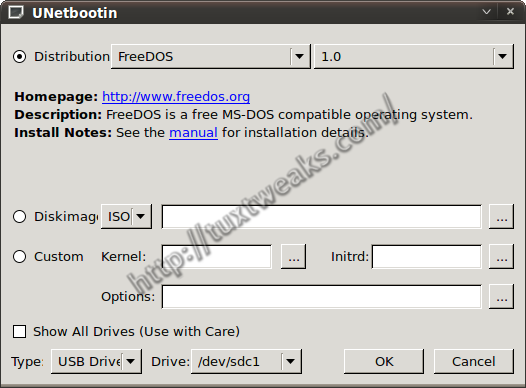
UNetbootin will begin downloading FreeDOS for you and install it to your flash drive.
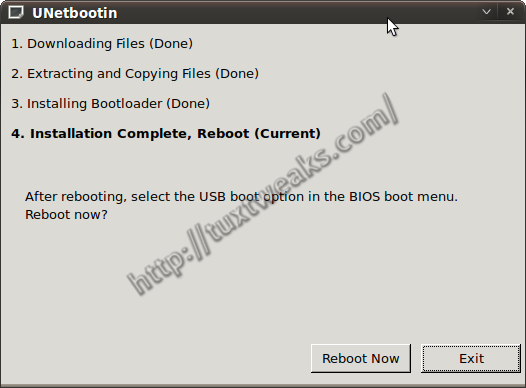
Once the process is complete, you can reboot your computer. Make sure to set your BIOS to boot to USB.
Comments
12 Responses to “Create a Bootable FreeDOS USB Drive on Linux With UNetbootin”
Leave a Reply Cancel reply
Subscribe by email
Top Content
- 6 Things To Do After Installing Ubuntu 13.04
- How To Control Fan Speeds in Ubuntu
- Remove Old Kernels In Ubuntu With One Command
- Send Gmail from the Linux Command Line
- How To Rotate The Screen in Ubuntu With The Nvidia Driver
- How to Configure Apache Web Server on Linux
- Fade Out Images with GIMP
- Install SSH and SFTP on Ubuntu or Linux Mint
- Review: Linux Mint 14 MATE Edition
- Installing a LAMP Server on Ubuntu
Categories
-
Archives
- ▼ 2013 (6)
- ► 2012 (19)
- ► 2011 (25)
- ► 2010 (56)
- ► Dec (4)
- ► Nov (3)
- ► Oct (4)
- ► Sep (4)
- ► Aug (3)
- ► Jul (5)
- ► Jun (4)
- ► May (8)
-
- How To Rotate The Screen in Ubuntu With The Nvidia Driver
- Lynx: A Text Only Web Browser
- Midori - A Lightweight Web Browser
- From The "WTF, Apple?" Dept.
- There's Always One Bad Apple
- Ubuntu on "The Big Bang Theory"
- Organize Your Recipes with Gourmet Recipe Manager
- Add an Open Terminal Button to Nautilus
- ► Apr (6)
- ► Mar (5)
- ► Feb (3)
- ► Jan (7)
- ► 2009 (88)
- ► Dec (4)
- ► Nov (5)
- ► Oct (7)
- ► Sep (6)
- ► Aug (13)
-
- Enable The RT2860STA Linux Wireless Driver
- Fade Out Images with GIMP
- Command Line Basics: Redirecting Output
- Command Line Basics: View Files With cat
- Command Line Basics: Determine File MIME Types
- Batch Watermark Images in Linux
- How To Watermark Images With ImageMagick in Linux
- Nautilus Script to Launch a Terminal
- SUSE Studio Screenshot Tour
- Edit Your GNOME Configuration
- Open Source Apps for Windows to Introduce Users to FOSS
- Name The Next Apple Product
- Fast Boot Your PC With Xandros Presto
- ► Jul (5)
- ► Jun (7)
- ► May (11)
-
- Command Line Basics: Create Custom Commands with Alias
- Command Line Basics: List Files with ls
- Space Saving Tips for Your GNOME Desktop
- Windows Web Browser Shootout
- Command Line Basics: Navigating the File System
- Bash to Basics: Print Text with echo
- Command Line Basics: echo
- Install the Firefox 3.5 Beta in Linux
- Create a Bootable USB Drive with Ubuntu and FreeDOS
- Revert the Update Behavior in Jaunty to the Old Way
- Who Needs Windows?
- ► Apr (11)
-
- Install Picasa 3.0 for Linux (beta)
- Eight Reasons Your Next Computer Should Run Linux
- Jaunty Boots 32% Faster on the MSI Wind
- The Jackalope is Jaunting!
- Windows 7 Won't Close the Door For Linux
- Upgrade Ubuntu with a CD Image
- Get a Jump on Jaunty Jackalope
- Secure File Transfer in Nautilus with SFTP
- Add the NT Backup Tool to Windows XP
- Why I hate Dell
- How To Install AVG Antivirus 7.5 in Ubuntu
- ► Mar (13)
-
- Create an Encrypted Folder in Ubuntu with Cryptkeeper
- How To Create Multiple Firefox Profiles in Windows
- Install the Fedora 10 Desktop Theme in Ubuntu
- Download the Fedora 10 Wallpaper
- How To Install the Echo Icon Theme in Ubuntu
- How To Install the Nodoka Theme Engine in Ubuntu
- Create Your Own .deb Packages with Checkinstall
- Install Your Own Ringtones with Ubuntu and BitPim
- Install Multimedia Codecs in Ubuntu 8.04
- Use Linux to Solve the Linux Journal Scramble
- Dvorak Rings Death Knell for Microsoft's Business Model
- Microsoft to Release Windows Linux!
- Review: Sabrent 68 in 1 Internal Card Reader
- ► Feb (2)
- ► Jan (4)
- ► 2008 (37)
- ► Dec (8)
-
- Update: Logitech LX8 in Ubuntu
- Create a Button to Restart USB in Ubuntu
- Create an Ubuntu Live USB Drive
- Install Fedora Cursor Theme in Ubuntu
- Change the Week Start Day in Ubuntu
- Automatically Update the ClamAV Virus Database
- Add On-Demand Virus Scanning to Nautilus
- Put Your Own Face on Tux - Wii Fit Review
- ► Nov (6)
- ► Oct (8)
-
- Ubuntu 8.10 is Out!
- Split mp3 Files With mp3splt
- How To Install RealPlayer 11 in Ubuntu
- How To Install Free42 in Ubuntu
- Review - Sony MDR-NC6 Noise Canceling Headphones
- How To Set Up a Home Network With Ubuntu, Part 3
- How To Set Up a Home Network With Ubuntu, Part 2
- How To Set Up a Home Network With Ubuntu, Part 1
- ► Sep (6)
- ► Aug (9)
-
- How To Control Fan Speeds in Ubuntu
- How To Install avast! Antivirus in Windows XP
- How to Launch a Program in Ubuntu Without Using The Menu
- Review - Logitech LX8 in Windows XP
- Google Starts "Free The Airwaves" PR Campaign
- Review - Logitech LX8 Cordless Laser Mouse
- Subway Doesn't Like Linux!
- How To Add An Item To Ubuntu's Menu
- How to resample MP3 audio files on Linux using LAME
Favorite Sites


Story added...
This story has been submitted to fsdaily.com! If you think this story should be read by the free software community, come vote it up and discuss it here:
http://www.fsdaily.com/EndUser/Create_a_Bootable_FreeDOS_USB_Drive_on_Linux_With_UNetbootin...
[...] Create a Bootable FreeDOS USB Drive on Linux With UNetbootin [...]
This Program is FANTASTIC , good post and good work to the developers
Get a "no operating system" message on USB boot
I sometimes have problems re-using a USB stick with UNetbootin. Try formatting the drive first and then re-run UNetbootin to set up your flash drive.
I know this is old but I am getting a similar message "missing operating system". How do you format your usb drive ? fat16 512mb ..etc ?
It's been a while since I've done this, but I think I've always used FAT32.
Unetbootin is a nice app so kudos to the developers. One thing I could not figure out. After I have made my bootable FreeDOS USB stick with Unetbootin it boots fine. But when I mount the USB stick on my desktop, add a firmware.exe to the USB stick, sync, unmount and boot from the USB stick again then the firmware.exe file does not show up. Anyone know how to fix this? Thanks!
IIRC, when you boot to FreeDOS, it drops you to a C: prompt. The files on your flash drive will actually show up under the A: drive, so just issue the a: command to change to the the A: drive, then you should see your firmware.exe file.
After messing around for over an hour trying to make a bootable USB stick in Fedora to update my BIOS, I found this page, and it was done in less than 20 minutes. Absolute life-saver (my BIOS was revision A04, with all kinds of problems, and the latest is A11 - big changes!).
In my case, I found that placing the BIOS update executable on the USB stick allowed it to be accessed from C: drive after booting the stick (i.e. the stick boots onto A: drive. To get to C: drive, simply type "C:". Then you can type "dir" to see the files).
After having a lot of trouble with failing to boot from flash drive eventually solved by removing all flash partitions and formatting whole drive as EXT4. Than removed that and created 2 new partitions, one FAt16 to hold the floppy image and then to get more space I created another one FAT32 of 20MB. The second partition could be accessed by D:.
Sounds easy now but a lot of messing about to get there.
Thanks for the tips.